
If you walk into a commercial kitchen today, you are stepping into a time warp. Amidst high-speed induction burners, automated inventory tracking, and POS systems that process payments in milliseconds, you will almost invariably find a laminated piece of paper hanging on the wall or clipped to a walk-in cooler door: the manual temperature log.
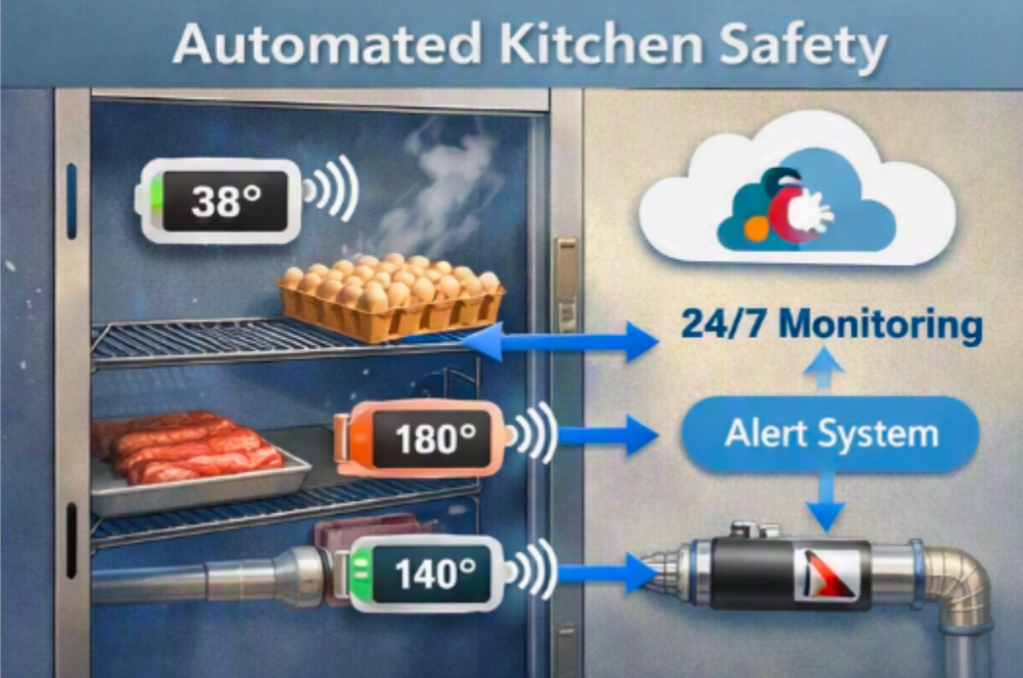
Every few hours, a line cook is pulled away from knife work and heat management to open a door, poke a probe into a box of chicken, and scribble down a number with a Sharpie.
It is an absurd operational bottleneck. Worse, it is an illusion of safety.
Between “pencil-whipping” (where busy staff just fill out the whole week’s clipboard at once) and transient temperature spikes that happen completely unnoticed between checks, manual logs offer virtually zero real-time protection. Yet, health departments still treat these pieces of paper as the gold standard of public safety, descending upon restaurants once a year for a subjective, theatrical walkthrough that catches almost nothing of consequence
It is time to kill the clipboard. Public health enforcement needs to transition from a reactive police force into a closed-loop, automated utility.
The Architecture of an Automated Safety Net
The technology to solve this has existed for years, and it is dirt cheap. For about ten dollars, you can buy an IoT sensor that drops into a cooler or straps onto a water line, streaming continuous telemetry over the cloud.
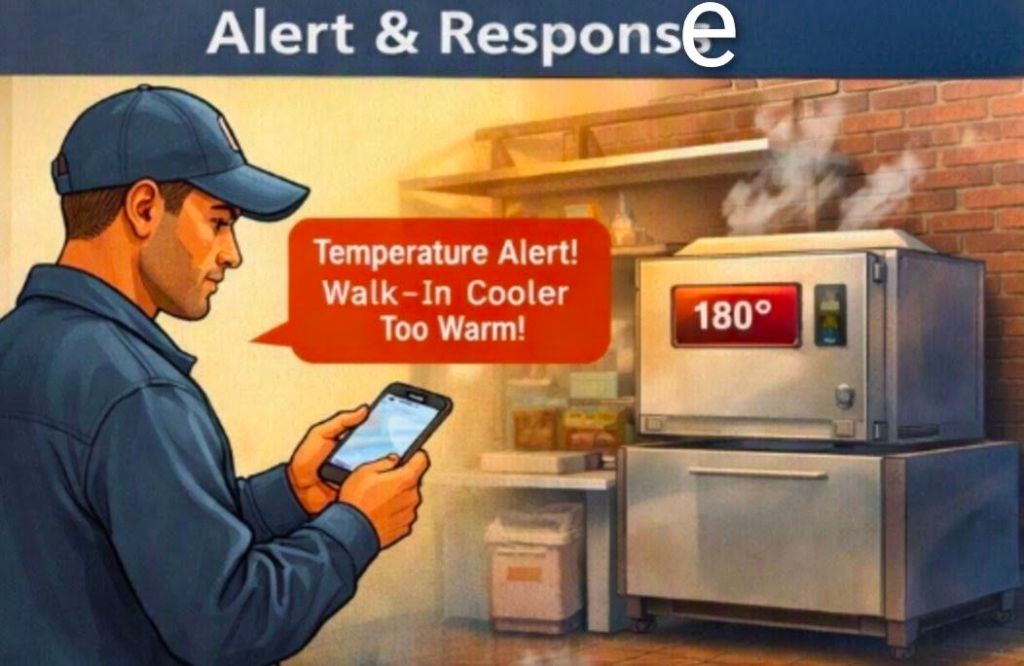
Instead of relying on human data entry, municipalities could modernize public health oversight by deploying a closed-loop compliance protocol built on four pillars:
- Continuous Telemetry & Exception Routing: Sensors monitor walk-in temperatures, dish machine rinse cycles (180^\circ\text{F} sanitizing heat), and hot water delivery lines 24/7. The system doesn’t drown inspectors in data; it uses a rules engine that listens exclusively for exceptions—like a cooler creeping above 41^\circ\text{F} for more than 30 minutes, or a hot water heater failing mid-service.
- Automated Field Service Dispatch: When a sensor trips, the system doesn’t wait for an inspector to notice three months from now. It automatically dispatches a certified technician to the site within a tight service-level agreement window.
- The Root-Cause Triage: The technician arrives assuming a sensor/hardware fault. If the sensor is fine, but the water heater is genuinely dead, the system shifts into enforcement mode.
- Instant Financial Throttling (The Kill Switch): If the infrastructure has failed and basic safety cannot be verified, the ultimate enforcement mechanism doesn’t require a sheriff padlocking the door. A secure API call to the merchant gateway or point-of-sale processor instantly pauses transaction processing. The restaurant’s cash register stops accepting payments.
Fairness Through Code
Critics might call automated financial throttling or instant shutdowns harsh. In reality, it is the absolute pinnacle of fairness.
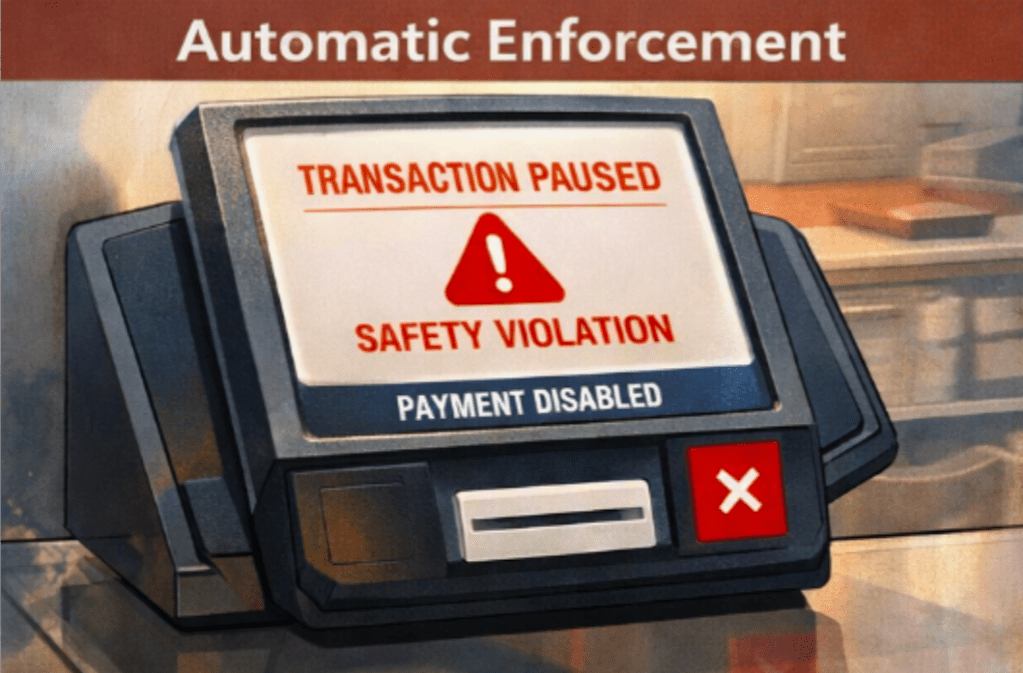
Human-driven regulatory enforcement is inherently flawed. It is subject to arbitrary inspector moods, inconsistent standards between neighborhoods, and the temptation of administrative favoritism.
Code doesn’t have bad days. A temperature threshold of 41^\circ\text{F} applies with identical, unyielding mathematical precision to every single establishment—from a massive corporate franchise down to an independent diner.
Furthermore, the system is entirely self-rehealing. Under a traditional manual shutdown, getting re-inspected can take days or weeks of red tape while a business bleeds money waiting for an inspector’s schedule to clear. With an automated loop, the moment the plumber replaces the heating element and the sensor registers stable, compliant temperatures for a required duration, the API fires, the payment gateway unlocks, and the doors are open for business again. Zero bureaucracy. Zero downtime wasted on waiting for human permission.
Let Cooks Cook
Cooks are not aviation flight engineers. Their job is execution, timing, and culinary craft under intense pressure—not running analog paperwork rituals and chasing down network dropouts.

By automating the telemetry, we remove a useless administrative burden from kitchen staff and replace it with an incorruptible digital safety net.
Under this model, the annual human inspection doesn’t disappear; it evolves. Instead of wasting time playing gotcha over a temperature log or a water heater that happened to be working five minutes ago, human inspectors can focus on what only humans can do: evaluating structural cross-contamination risks, deep sanitation practices, and pest control.
Day-to-day safety is guaranteed by code. The human element is elevated to actual high-level auditing. It’s time to take the Sharpies away from the line cooks, hook the infrastructure directly into the municipal backbone, and let public health enter the twenty-first century.
 Mavrik Concepts