
Bentonville, AR — Walmart’s 2025 delivery transformation is reshaping the U.S. logistics landscape, driven by a sophisticated software stack and a bold shift toward ultra‑fast fulfillment. While many retailers continue to debate same‑day versus next‑day delivery, Walmart has moved the benchmark entirely.
“We’re not optimizing for days anymore,” said John Furner, President & CEO of Walmart U.S. “We’re optimizing for minutes. That’s the expectation customers have, and we intend to lead.”
The company’s strategy is powered by a 9‑layer delivery infrastructure that blends geospatial intelligence, predictive inventory, drone routing, and white‑label fulfillment.
Five Strategic Moves, One Integrated System
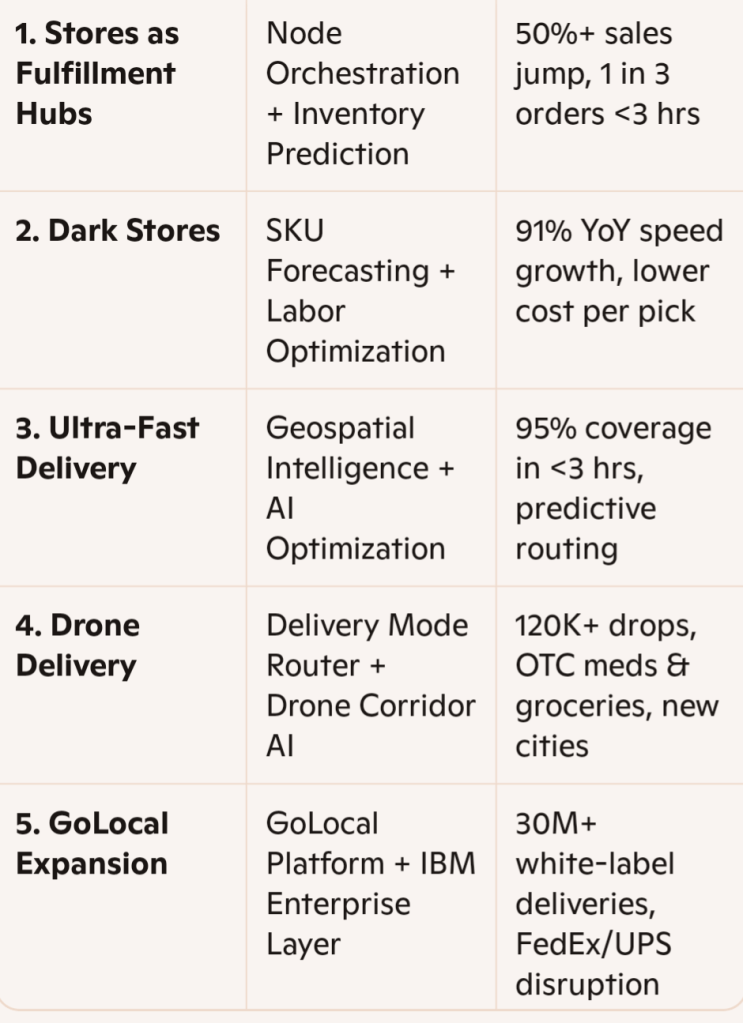
Walmart’s delivery acceleration is anchored in five major initiatives:
– Stores as Fulfillment Hubs
– Dark Stores
– Ultra‑Fast Delivery
– Drone Delivery
– GoLocal Expansion
Each move is supported by a corresponding technology layer, creating a unified logistics engine that operates in real time.
“We’re leveraging our physical footprint in ways the industry hasn’t seen before,” said Suresh Kumar, Walmart’s Global CTO. “The combination of data, proximity, and automation is what unlocks speed at scale.”
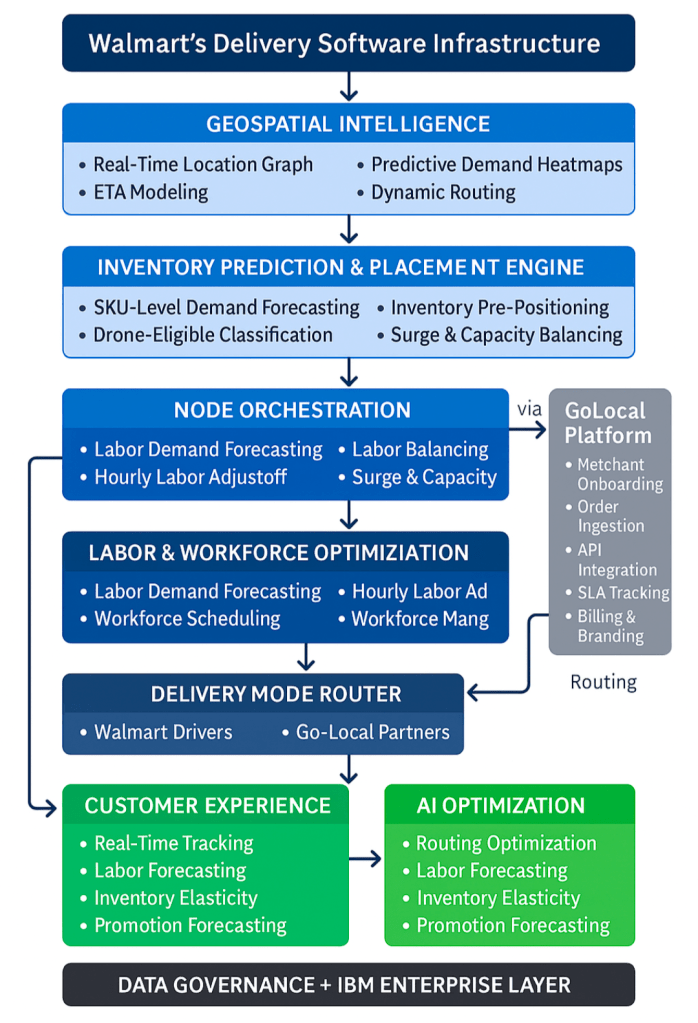
The 9‑Layer Software Infrastructure Behind the Shift
Walmart’s Delivery Software Infrastructure
At the core of Walmart’s transformation is a multi‑layered system designed to orchestrate every component of the last mile:
1. Geospatial Intelligence
Real‑time location graphs, ETA modeling, and predictive heatmaps guide routing decisions.
2. Inventory Prediction & Placement
AI forecasts demand and positions SKUs closer to customers.
3. Node Orchestration
Orders are dynamically routed between stores, dark stores, and micro‑fulfillment centers.
4. Labor & Workforce Optimization
Staffing adjusts automatically based on demand surges and forecasted volume.
5. Delivery Mode Router
The system selects between drivers, drones, and GoLocal partners.
6. GoLocal Platform
A white‑label delivery engine used by retailers nationwide.
7. Customer Experience Layer
Real‑time tracking, substitutions, and loyalty integration.
8. AI Optimization
Reinforcement learning improves routing, labor allocation, and inventory elasticity.
9. Data Governance + IBM Enterprise Layer
Ensures compliance, security, and multi‑tenant onboarding.
Drone Delivery Reaches Scale
Walmart’s drone program expanded rapidly in 2025, completing more than 120,000 deliveries across multiple metro areas.
“Drone delivery is no longer experimental for us,” said David Guggina, EVP of Supply Chain. “It’s a fully integrated part of our last‑mile network, and customers are adopting it faster than we expected.”
The company now delivers groceries, OTC medications, and household essentials by air in cities including Atlanta, Houston, Charlotte, Orlando, and Tampa.
GoLocal Becomes a National Delivery Utility
Walmart’s GoLocal platform—powered by IBM Sterling OMS—has completed more than 30 million white‑label deliveries for other retailers.
“We built GoLocal to give businesses of all sizes access to the same capabilities we use ourselves,” said Tom Ward, Chief E‑Commerce Officer. “It’s a win for local retailers and a win for customers.”
This expansion positions Walmart as a direct competitor to FedEx and UPS in the same‑day and next‑day delivery space.
A New Standard for Retail Logistics
Walmart’s 2025 delivery overhaul represents a fundamental shift in how retail logistics operate. By combining proximity, data, and execution speed, the company has created a supply chain operating system that may soon become the industry standard.
“We’re building the future of retail logistics in real time,” Furner said. “And we’re just getting started.”

