
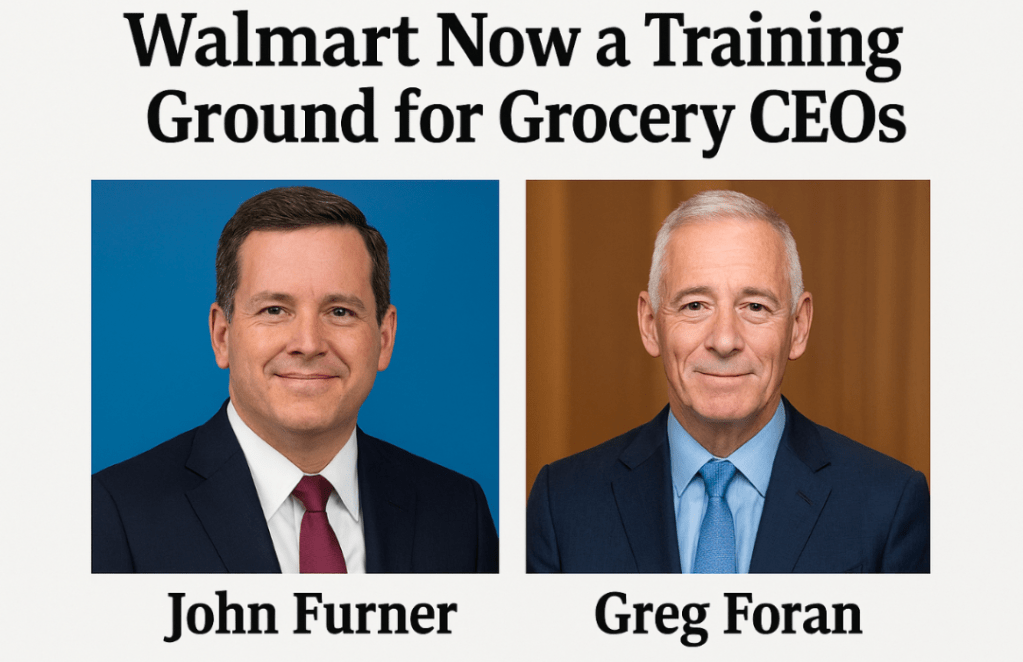
Two of the nation’s largest grocery retailers have turned to former Walmart executives to lead their companies, signaling the growing influence of Walmart’s management pipeline across the broader supermarket industry.
Walmart U.S. chief John Furner assumed the role of president and chief executive officer of Walmart Inc. on Feb. 1, following the retirement of longtime CEO Doug McMillon. Furner, who began his career as an hourly associate, spent more than 30 years rising through the company’s store, merchandising and operational ranks.
Days later, Kroger Co. announced that Greg Foran, who led Walmart’s U.S. business from 2014 to 2019, would become its next CEO. Foran is credited with stabilizing Walmart’s domestic operations during a period of intense competition and rapid digital expansion.
The two appointments place Walmart‑trained leaders at the helm of the country’s largest and second‑largest grocery sellers by revenue. Industry analysts say the moves highlight Walmart’s growing role as a training ground for executives capable of managing the scale, logistics and labor complexity that now define modern food retail.
Walmart’s U.S. division operates more than 4,600 stores and is responsible for one of the largest grocery businesses in the world. Executives who advance through the company’s system typically oversee multibillion‑dollar divisions, large workforces and high‑volume supply chains—experience that translates directly to the challenges facing traditional grocers.
Kroger’s decision to hire an external CEO marks a notable shift for the Cincinnati‑based company, which has historically promoted from within. Publix, another major U.S. grocer, continues to rely on internal succession and has not appointed outside leadership.
With Furner and Foran now leading two of the industry’s most influential companies, Walmart’s management bench is increasingly shaping the direction of the U.S. grocery sector at a time of rising competition, automation and consolidation.
 Mavrik Concepts