
Introduction
DoorDash has developed its own autonomous delivery robot, known as Dot. Dot is a compact, electric robot designed to travel on sidewalks, bike lanes, and neighborhood streets, providing a glimpse into the future of last-mile delivery automation. While DoorDash has announced expansion plans for Dot, its current rollout is limited to the greater Phoenix, Arizona area. As of now, Florida is not listed as an active deployment zone, and there is no public record or announcement that DoorDash has filed for Department of Transportation (DOT) approval in Florida.
Legal Framework
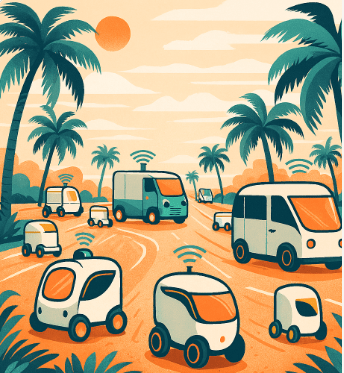
Florida has proactively established a legal framework for autonomous delivery robots, referred to as personal delivery devices (PDDs). In 2021, Florida updated its traffic code (Fla. Stat. §316.2071) to explicitly allow PDDs to operate on sidewalks and crosswalks statewide. These devices are treated similarly to pedestrians, with specific requirements and restrictions:
- Yielding: PDDs must yield to people on sidewalks.
- Street Crossing: They may cross streets at crosswalks but are prohibited from driving down highways.
- Identification: Each device must display a unique ID plate or marker, including the operator’s name and contact information.
- Safety: Devices must have a braking system capable of controlled stops and must be monitored remotely by an operator.
- Insurance: Operators are required to carry at least $100,000 in liability insurance for their fleet.
What This Means for DoorDash
The legal framework in Florida is already in place, meaning companies like DoorDash, Amazon, or Uber Eats can apply to deploy robots in the state. However, there is no public record that DoorDash has filed with the Florida DOT or launched pilots in Florida. Dot remains confirmed only in Arizona pilots. Florida is “open for business” legally, but DoorDash has not yet taken the step to operate here.
Florida Statute §316.2071 — Personal Delivery Devices & Mobile Carriers
Where They Can Operate
- Allowed on sidewalks and crosswalks statewide.
- PDDs have the same rights and duties as pedestrians but must not unreasonably interfere with people or traffic.
- May cross streets at crosswalks but cannot drive down public highways.
Equipment & Identification
- Must obey all traffic and pedestrian signals.
- Must display a unique ID plate/marker with operator name and contact info.
- Must have a braking system capable of bringing the device to a controlled stop.
Monitoring & Control
- PDDs must be actively monitored or controlled remotely by an operator.
- For “mobile carriers” (devices that follow a person), the owner must remain within 25 feet.
Restrictions
- Cannot transport hazardous materials.
- Cannot transport people or animals (applies to mobile carriers).
Insurance Requirement
- Operators must maintain at least $100,000 in general liability coverage for damages arising from their fleet’s operations.
Why This Matters
Florida is “robot-ready”: The legal framework is already in place, so companies like DoorDash, Amazon, or Starship don’t need new laws—just DOT filings and local coordination. If DoorDash’s Dot or similar robots launch here, they could legally run on sidewalks in Palm City, Miami, Orlando, and other cities. This opens the door for last-mile automation pilots in Florida, especially in dense urban or campus environments.
Why Florida Did This
- Pro-innovation stance: Florida has consistently positioned itself as a friendly state for autonomous vehicles and drones.
- Economic development: Lawmakers wanted to attract pilot programs from companies like Amazon, DoorDash, and FedEx.
- Uniformity: By codifying PDD rules statewide, they avoided a patchwork of city ordinances that could slow adoption.
The Result
Florida became one of the first states in the U.S. to explicitly legalize sidewalk delivery robots. The statute gives robots the same rights and duties as pedestrians, with added safety and accountability requirements. Today, the law is still in place, even though companies like DoorDash haven’t yet filed to operate in Florida.
Legislative Champions & Industry Support
Jason Fischer & Autonomous Vehicle Legislation
- Rep. Jason Fischer (R-Jacksonville): Sponsored Florida’s key AV bills (HB 1027 in 2017, HB 311 in 2019), positioning Florida as one of the most AV-friendly states in the U.S.
- Sen. Jeff Brandes (R-St. Petersburg): Longtime advocate for autonomous vehicle legislation.
- Campaign Finance: Fischer’s political committees and campaigns received contributions from transportation, tech, and infrastructure-aligned PACs and companies. Support often flows through automotive & logistics PACs (Ford, GM, UPS, FedEx), tech & telecom companies (AT&T, Comcast), engineering & infrastructure firms tied to SunTrax (Florida’s AV test facility), and industry associations like the Alliance for Automotive Innovation (Waymo, Cruise, Aurora, etc.).
Donor Categories Linked to AV Policy
- Transportation & Logistics PACs: UPS, FedEx, and trucking associations have lobbied in Florida on AV and delivery tech.
- Automotive & Dealer Associations: Florida Automobile Dealers Association and national auto PACs (Ford, GM, Toyota) have contributed to pro-AV legislators.
- Tech & Telecom Donors: AT&T, Comcast, and telecom PACs supported Fischer and Brandes.
- Engineering & Infrastructure Firms: Companies tied to SunTrax have supported lawmakers pushing AV bills.
- Healthcare & Insurance Cross-Support: Insurers have a stake in liability frameworks for autonomous vehicles.
Key Takeaway
Fischer’s AV push wasn’t bankrolled by one flashy Silicon Valley name. Instead, it was coalition money—transportation, telecom, auto, and infrastructure groups all aligning to make Florida a testbed for autonomous tech.
Conclusion
Florida’s legal framework for personal delivery devices is robust and forward-thinking. The state has positioned itself as a leader in autonomous vehicle and delivery technology, with laws that explicitly allow sidewalk delivery robots and set clear requirements for safety, monitoring, and insurance. While DoorDash’s Dot robot is not yet operating in Florida, the path is clear for deployment. Operators and investors should recognize Florida as a prime location for last-mile delivery innovation, with supportive legislation and a welcoming business environment.
Call to Action
If you are an operator, investor, or policymaker, Florida offers a ready-made legal environment for autonomous delivery robots. The state’s laws are in place—now it’s up to industry leaders to take the next step and bring the future of delivery to Florida’s sidewalks.
Core References on Florida AV Law & Debate
- Florida Bar Journal – “Navigating the Road Ahead” (2015) Early analysis of Florida’s AV statute, explaining how the state positioned itself as a leader in self‑driving car legislation and the liability questions it raised.
- Phelps Law Review – “An Attempt to Control What Controls Itself” (2019) A deep dive into Florida’s AV laws, highlighting both the opportunities and the risks of being an early adopter. It discusses how state laws interact with federal NHTSA standards.
- Russo Law – Florida’s Autonomous Vehicle Statute A practitioner’s breakdown of Florida’s AV law, including definitions, registration requirements, and even how entertainment screen restrictions were lifted for AVs.
 Mavrik Concepts