
Artificial Intelligence (AI) is revolutionizing the restaurant industry by enhancing efficiency, optimizing resources, and personalizing guest experiences. This article explores four key areas where AI is making a significant impact:
- Menu Intelligence & Predictive Demand
- Inventory Optimization & Waste Reduction
- Guest Behavior Modeling
- Staffing & Labor Efficiency
Each of these areas leverages advanced data analytics and machine learning to drive smarter decision-making and improve overall operations. Let’s dive into each section to understand how AI is transforming the restaurant landscape.
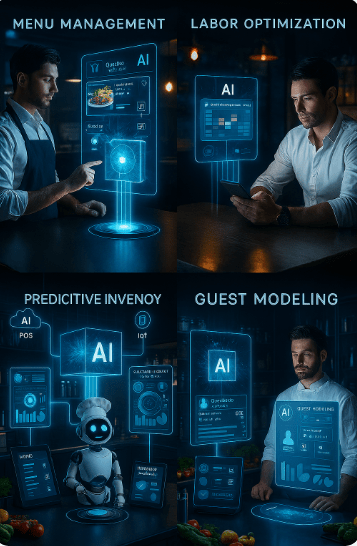
The Hidden Core: Where Restaurant AI Actually Lives
Most restaurant AI platforms—like Toast, Square for Restaurants, Upserve, Restaurant365, and BlueCart—market themselves as guest-facing tools. However, the real intelligence lies not in the POS screen or chatbot, but in the data and engineering centers that power:
- Menu Intelligence & Predictive Demand
Toast uses AI to predict busy periods and optimize menu performance. The engine behind this is a data pipeline that ingests historical sales, weather, local events, and staffing patterns. Their menu management isn’t just a UI; it’s a machine learning model trained on SKU-level performance across thousands of locations.
What Is SKU-Level Learning?
A SKU (Stock Keeping Unit) is a unique identifier for every menu item variation, down to size, modifier, or ingredient. Toast tracks how each SKU performs, including frequency of order, time of day, location, guest type, and how it pairs with other items. This granular data becomes the training set for machine learning models that:
- Predict which items will sell best at specific times or locations.
- Recommend pricing adjustments based on demand elasticity.
- Flag underperforming items for potential removal or rebranding.
- Suggest upsell combinations based on historical guest behavior.
How It Works Behind the Scenes
Toast’s engineering team uses cloud-based data lakes to store SKU performance across all clients, ML frameworks (likely TensorFlow or PyTorch) to train models on menu dynamics, and benchmarking algorithms to compare your menu’s performance against anonymized data from similar restaurants. This allows Toast to offer features like:
- Menu Manager & Publishing Center: Schedule price changes and item rollouts across multiple locations.
- AI Benchmarking: See how your menu stacks up against industry averages and identify revenue opportunities.
Toast does not share raw data between its restaurant clients. Each merchant’s data—menu performance, guest behavior, inventory logs—is treated as proprietary and protected under Toast’s Privacy Statement. However, Toast leverages aggregated and anonymized data across its network to power features like benchmarking tools and machine learning models.
2. Inventory Optimization & Waste Reduction
BlueCart and Restaurant365 use AI to forecast inventory needs. This involves real-time supplier data, predictive algorithms for perishables, and integration with accounting systems to model cost impact. These platforms often rely on cloud-based data lakes and ETL pipelines to unify disparate inputs—supplier APIs, POS logs, and even IoT sensor data from walk-ins.
BlueCart: Predictive Inventory & Smart Ordering
BlueCart’s AI streamlines the supply chain and reduces waste by forecasting exactly what and when to order. Key features include:
- Predictive Ordering Engine: Uses historical depletion rates, real-time inventory levels, and seasonality trends to recommend precise reorder quantities.
- Par Level Adjustments: Automatically recalibrates par levels based on actual usage.
- Vendor Intelligence: Integrates supplier performance data to optimize timing and cost of orders.
- Menu Profitability Benchmarking: Compares your menu’s contribution margin against a network of 125,000 restaurants to guide smarter purchasing.
Restaurant365: Real-Time Forecasting & Budget Integration
Restaurant365 takes a broader operational view, using AI to align inventory, labor, and financial planning across locations. Key features include:
- Automated Inventory Forecasting: Pulls real-time data from POS systems to predict food usage and reorder needs.
- Location-Specific Forecasts: Adjusts for seasonality, local demand, and historical trends at each unit.
- Labor & Inventory Sync: Aligns staffing schedules with inventory forecasts to reduce over-ordering and waste.
- Revenue Center Forecasting: Breaks down demand by meal period or service type to fine-tune purchasing.
3. Guest Behavior Modeling
Upserve tracks dish popularity and guest preferences using collaborative filtering algorithms—similar to Netflix or Spotify—to personalize upsells and loyalty nudges. These models require feature engineering from structured and unstructured data: reviews, order timing, modifiers, and even sentiment from feedback.
What Is Collaborative Filtering in Upserve?
Collaborative filtering is a type of machine learning that makes predictions based on patterns of similarity between users and items. In Upserve’s case, it means analyzing guest behavior across thousands of restaurants, identifying patterns in what similar guests tend to order, and recommending actions based on those patterns.
4.Staffing & Labor Efficiency
Restaurant365 automates labor scheduling using AI. This isn’t just a calendar; it’s a constraint-based optimization model that balances labor laws, availability, and forecasted demand.
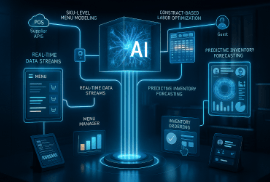
Smart Labor: AI-Powered Staffing Precision Restaurant365 uses an advanced algorithm that analyzes sales data from the past 8 weeks, broken down by operating hour and weekday, to generate hour-by-hour staffing forecasts. This eliminates guesswork and helps prevent both overstaffing and understaffing
 Mavrik Concepts