
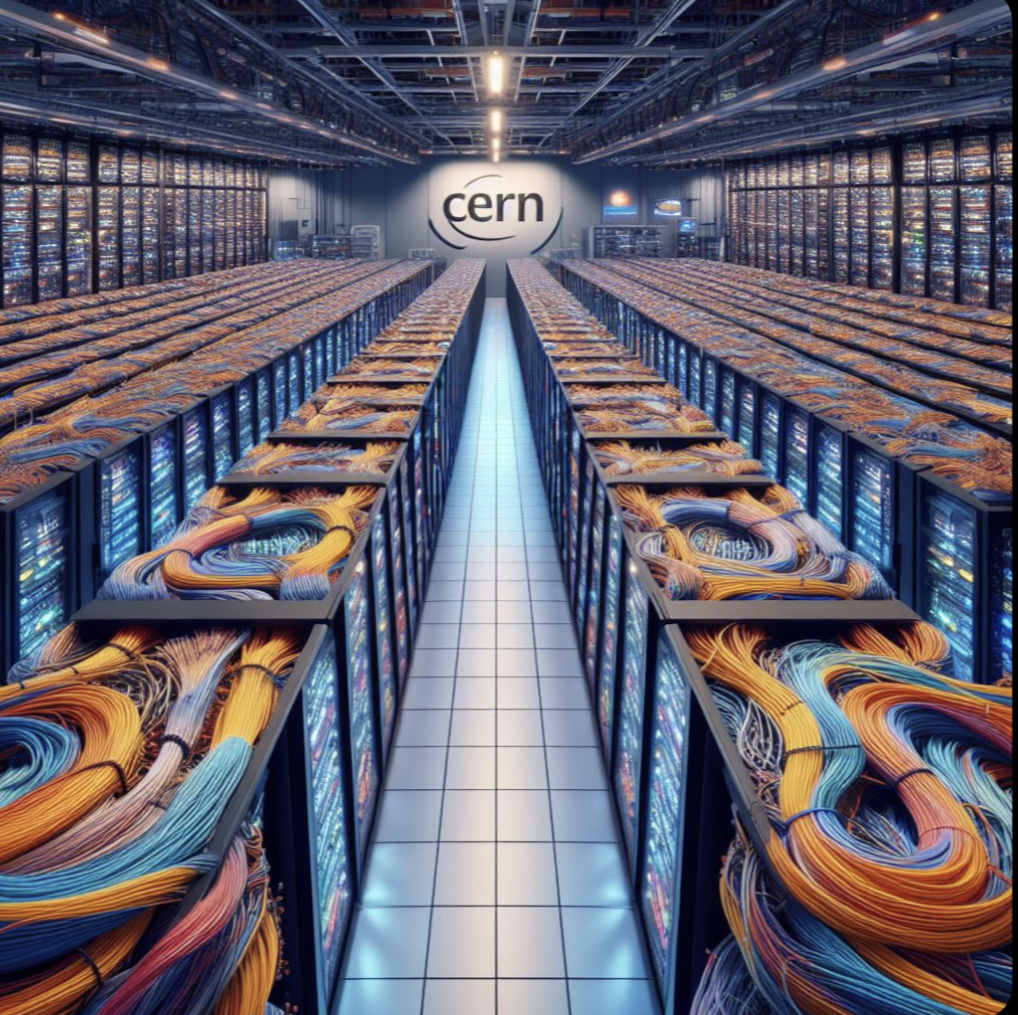
In the quaint town of Prévessin, France, a monumental leap in scientific data management has taken place. The European Organization for Nuclear Research, commonly known as CERN, has inaugurated a new data center designed to handle the colossal data streams from the world’s largest and most powerful particle accelerator, the Large Hadron Collider (LHC).
A Titan of Data Processing
The new facility, sprawling over 6,000 square meters, is a testament to CERN’s forward-thinking approach to data processing. With six rooms, each boasting a cooling capacity of 2 megawatts, the center is primarily tasked with processing physics data. However, its role extends beyond the realms of particle physics, providing crucial support for business continuity and disaster recovery operations.
The Heartbeat of the LHC
The LHC’s data production is staggering, churning out approximately 45 petabytes of data weekly. This figure is set to double following the completion of the High-Luminosity LHC upgrade. To manage this data deluge, CERN relies on the Worldwide LHC Computing Grid (WLCG), a global collaboration of around 170 data centers, offering a combined storage capacity of roughly 3 exabytes and over one million CPU cores.
Sustainability at Its Core
Constructed in under two years, the Prévessin data center is not only a marvel of engineering but also of environmental sustainability. It features an innovative heat recovery system that repurposes excess heat to warm local buildings. Moreover, the center aims for a Power Usage Effectiveness (PUE) target of 1.1, showcasing its commitment to energy efficiency.
The Backbone of Big Data
At the heart of CERN’s data infrastructure lies the EOS (Exabyte Open Storage) filesystem. This in-house developed, open-source platform is tailored for the vast datasets produced by LHC experiments. Its architecture, which separates metadata from data, enhances scalability and performance, making it a cornerstone of CERN’s data management strategy.
Challenges and Innovations
Managing such an extensive data center comes with its own set of challenges. Cost and power efficiency are significant concerns, especially given CERN’s reliance on public funding. Innovations in storage technology, such as the integration of flash storage and efficient JBOD designs, are crucial for maintaining and expanding the facility’s capabilities within budgetary constraints.
CERN’s exabyte data center stands as a critical component of the global scientific research infrastructure. It not only supports the groundbreaking experiments conducted at the LHC but also pioneers new standards in big data handling. This facility is a beacon of innovation, propelling scientific discovery into a new era.
 Mavrik Concepts